
UC Irvine Giving Day
Pediatrics - The Lost Enzyme Project
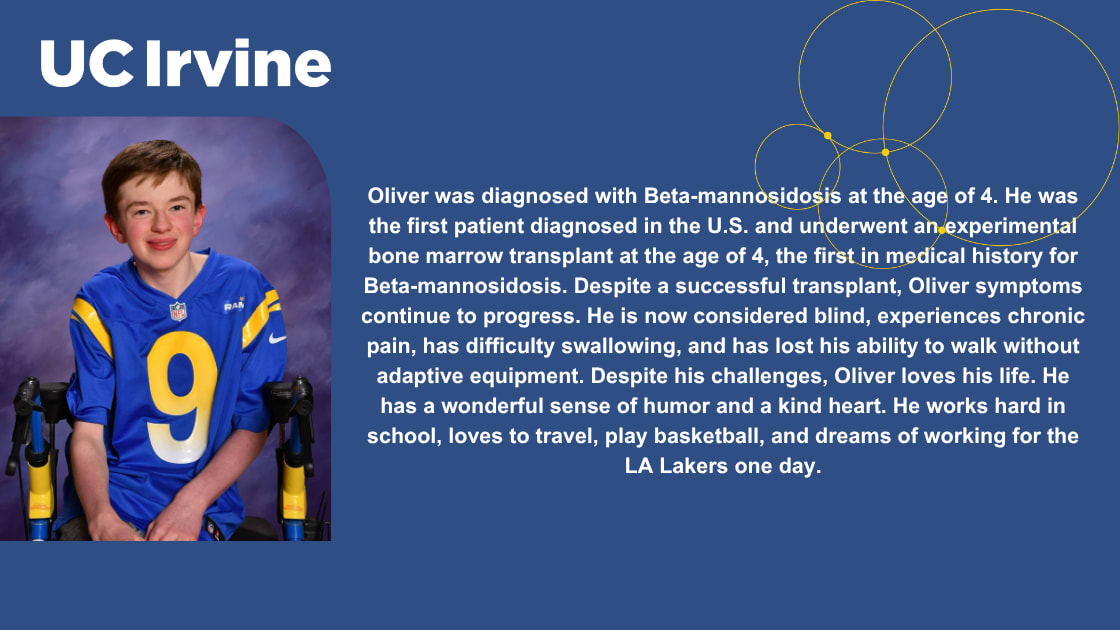
The road to a rare disease diagnosis is often long and grueling. Those diagnosed with Beta-mannosidosis arrive at a devastating prognosis—Beta-mannosidosis is a progressive disease with no treatment. Patients and their families have struggled to find hope for this under-researched and poorly understood disease.
The Lost Enzyme Project was created by the families of patients diagnosed in the United States, in collaboration with the Kimonis Lab at the University of California, Irvine to complete the preclinical studies necessary for the development of an enzyme replacement therapy for Beta-mannosidosis.
JCR Pharmaceuticals has partnered with Kimonis Lab to develop β-Mannosidase, the enzyme lost in Beta- mannosidosis patients, utilizing its patented, state-of-the-art J-Brain Cargo® technology. J-Brain Cargo® is the first technology proven to penetrate the blood-brain barrier to deliver treatment to the central nervous system in humans. The experimental therapeutic will be used to test its utility in an animal model of beta-mannosidosis as well as human cells with the goal of creating human clinical trials.
WHAT IS BETA-MANNOSIDOSIS?
Beta-mannosidosis (β-mannosidosis) is an extremely rare genetic disease that belongs to a larger group of lysosomal storage disorders (NORD, 2023). Changes in the MANBA gene cause metabolic abnormality, specifically a loss of a functional β-Mannosidase enzyme, resulting in the build-up of toxic materials in the cells throughout the body and brain.
The severity and progression of the disease varies widely in individuals and symptoms can appear in infancy through adulthood. Most affected individuals experience some degree of intellectual disability and delayed motor development. Other signs and symptoms include speech delay, swallowing and hearing difficulties, repeat infections, seizures, gross and fine motor delay, low muscle tone, scoliosis, nystagmus, white matter changes to the brain (leukoencephalopathy), reduced sensations in extremities and behavioral and psychiatric challenges.
YOUR IMPACT
The project’s design is intended to support the following goals:
GOAL 1: Clinical characterization and natural history studies.
GOAL 2: Utilization of fribroblast cell lines for translational (treatment) studies.
GOAL 3: Translational studies in neuronal cell lines derived from patient iPSCs (induced pluripotent stem cells).
GOAL 4: Conduct scientific lab work including a mouse model.
We thank you for donating to the Rare Disease Fund this Giving Day in support of the Lost Enzyme Project. The groundbreaking enzyme replacement treatment will transform the outcomes of people diagnosed with Beta-mannosidosis around the world.
To learn more about the Lost Enzyme Project and patient stories please click here.


Use #UCIGivingDay to join in the fun!
Pediatrics - The Lost Enzyme Project Donor Map
| Rank | Prize | Chapter | % +/- | Goal |
|---|---|---|---|---|
| 1 | Institute for Transportation Studies | 0.00% |
$0.00
goal: $0.00
|
|
| 2 | Train New Trainers (TNT) Primary Care Fellowships | 0.00% |
$0.00
goal: $0.00
|
|
| 3 | Emergency Research Support Fund | 0.00% |
$0.00
goal: $0.00
|
|
| 4 | Parent and Family Engagement | 0.00% |
$0.00
goal: $0.00
|
|
| 5 | Claire Trevor School of the Arts | 0.00% |
$0.00
goal: $0.00
|
|
| 6 | Donald Bren School of ICS | 0.00% |
$0.00
goal: $0.00
|
|
| 7 | Dunlop School of Biological Sciences | 0.00% |
$0.00
goal: $0.00
|
|
| 8 | Access UCI | 0.00% |
$0.00
goal: $0.00
|
|
| 9 | Aero Design Student Group | 0.00% |
$0.00
goal: $0.00
|
|
| 10 | Anteater Baja Racing Student Group | 0.00% |
$0.00
goal: $0.00
|
|
| 11 | Anteater Band | 0.00% |
$0.00
goal: $0.00
|
|
| 12 | Anteater Electric Racing Student Group | 0.00% |
$0.00
goal: $0.00
|
|
| 13 | Anteater Formula Racing Student Group | 0.00% |
$0.00
goal: $0.00
|
|
| 14 | Anteater Spirit Squad | 0.00% |
$0.00
goal: $0.00
|
|
| 15 | Anteaters Give Back Student Philanthropy Campaign | 0.00% |
$0.00
goal: $0.00
|
| Rank | Prize | Chapter | Donors |
|---|---|---|---|
| 1 | Institute for Transportation Studies | 0 | |
| 2 | Train New Trainers (TNT) Primary Care Fellowships | 0 | |
| 3 | Emergency Research Support Fund | 0 | |
| 4 | Parent and Family Engagement | 0 | |
| 5 | Claire Trevor School of the Arts | 0 | |
| 6 | Donald Bren School of ICS | 0 | |
| 7 | Dunlop School of Biological Sciences | 0 | |
| 8 | Access UCI | 0 | |
| 9 | Aero Design Student Group | 0 | |
| 10 | Anteater Baja Racing Student Group | 0 | |
| 11 | Anteater Band | 0 | |
| 12 | Anteater Electric Racing Student Group | 0 | |
| 13 | Anteater Formula Racing Student Group | 0 | |
| 14 | Anteater Spirit Squad | 0 | |
| 15 | Anteaters Give Back Student Philanthropy Campaign | 0 |

| Rank | Fund | Gifts |
|---|---|---|
| 1 | Institute for Transportation Studies | 0 |
| 2 | Train New Trainers (TNT) Primary Care Fellowships | 0 |
| 3 | Emergency Research Support Fund | 0 |
| 4 | Parent and Family Engagement | 0 |
| 5 | Claire Trevor School of the Arts | 0 |
| 6 | Donald Bren School of ICS | 0 |
| 7 | Dunlop School of Biological Sciences | 0 |
| 8 | Access UCI | 0 |
| 9 | Aero Design Student Group | 0 |
| 10 | Anteater Baja Racing Student Group | 0 |
| 11 | Anteater Band | 0 |
| 12 | Anteater Electric Racing Student Group | 0 |
| 13 | Anteater Formula Racing Student Group | 0 |
| 14 | Anteater Spirit Squad | 0 |
| 15 | Anteaters Give Back Student Philanthropy Campaign | 0 |
